Theorem. The angles (ACB, ADB) in the same segment of a circle are equal.
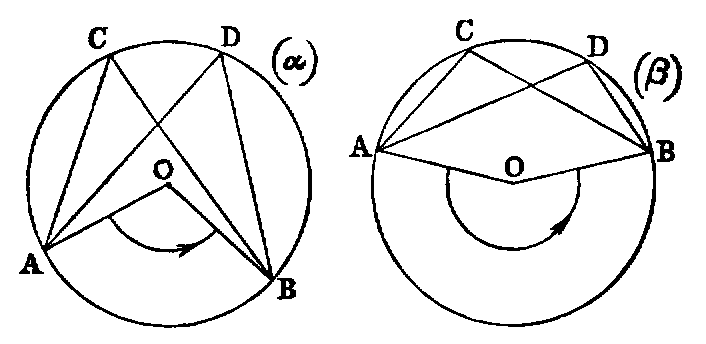
Dem.—Let O be the centre. Join OA, OB. Then the angle AOB is double of the angle ACB [xx.], and also double of the angle ADB. Therefore the angle ACB is equal to the angle ADB.
The following is the proof of the second part—that is, when the arc AB is not greater than a semicircle, without using angles greater than two right angles:—
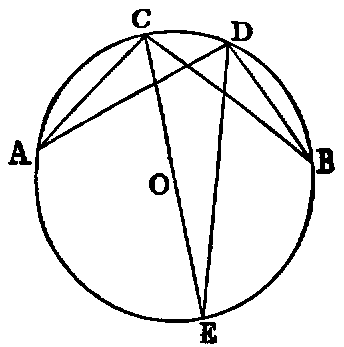
Let O be the centre. Join CO, and produce it to meet the circle again in E. Join DE. Now since O is the centre, the segment ACE is greater than a semicircle; hence, by the first case, fig. (α), the angle ACE is equal to ADE. In like manner the angle ECB is equal to EDB. Hence the whole angle ACB is equal to the whole angle ADB.
Cor. 1.—If two triangles ACB, ADB on the same base AB, and on the same side of it, have equal vertical angles, the four points A, C, D, B are concyclic.
Cor. 2.—If A, B be two fixed points, and if C varies its position in such a way that the angle ACB retains the same value throughout, the locus of C is a circle.
In other words—Given the base of a triangle and the vertical angle, the locus of the vertex is a circle.