i. Equal circles are those whose radii are equal.
This is a theorem, and not a definition. For if two circles have equal radii, they are evidently congruent figures, and therefore equal. From this way of proving this theorem Props. xxvi.–xxix. follow as immediate inferences.
ii. A chord of a circle is the line joining two points in its circumference.
If the chord be produced both ways, the whole line is called a secant, and each of the parts into which a secant divides the circumference is called an arc—the greater the major conjugate arc, and the lesser the minor conjugate arc.—Newcomb.
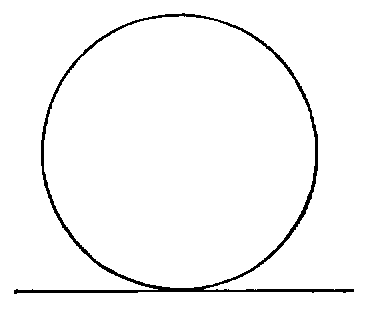
iii. A right line is said to touch a circle when it meets the circle, and, being produced both ways, does not cut it; the line is called a tangent to the circle, and the point where it touches it the point of contact.
In Modern Geometry a curve is considered as made up of an infinite number of points, which are placed in order along the curve, and then the secant through two consecutive points is a tangent. Euclid’s definition for a tangent is quite inadequate for any curve but the circle, and those derived from it by projection (the conic sections); and even for these the modern definition is better.
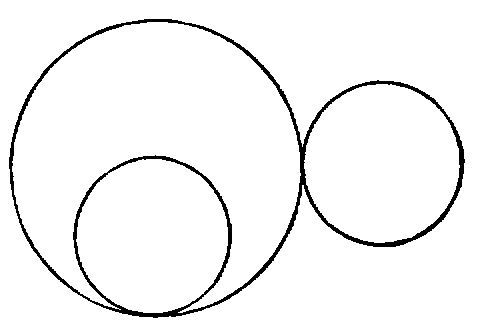
iv. Circles are said to touch one another when they meet, but do not intersect. There are two species of contact:—1. When each circle is external to the other.2. When one is inside the other.
The following is the modern definition of curve-contact:— When two curves have two, three, four, &c., consecutive points common, they have contact of the first, second, third, &c., orders.
v. A segment of a circle is a figure bounded by a chord and one of the arcs into which it divides the circumference.
vi. Chords are said to be equally distant from the centre when the perpendiculars drawn to them from the centre are equal.
vii. The angle contained by two lines, drawn from any point in the circumference of a segment to the extremities of its chord, is called an angle in the segment.
viii. The angle of a segment is the angle contained between its chord and the tangent at either extremity.
A theorem is tacitly assumed in this Definition, namely, that the angles which the chord makes with the tangent at its extremities are equal. We shall prove this further on.
ix. An angle in a segment is said to stand on its conjugate arc.
x. Similar segments of circles are those that contain equal angles.
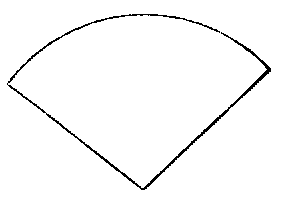
xi. A sector of a circle is formed of two radii and the arc included between them.
To a pair of radii may belong either of the two conjugate arcs into which their ends divide the circle.—Newcomb.
xii. Concentric circles are those that have the same centre.
xiii. Points which lie on the circumference of a circle are said to be concyclic.
xiv. A cyclic quadrilateral is one which is inscribed in a circle.
xv. It will be proper to give here an explanation of the extended meaning of the word angle in Modern Geometry. This extension is necessary in Trigonometry, in Mechanics—in fact, in every application of Geometry, and has been partly given in I. Def. ix.
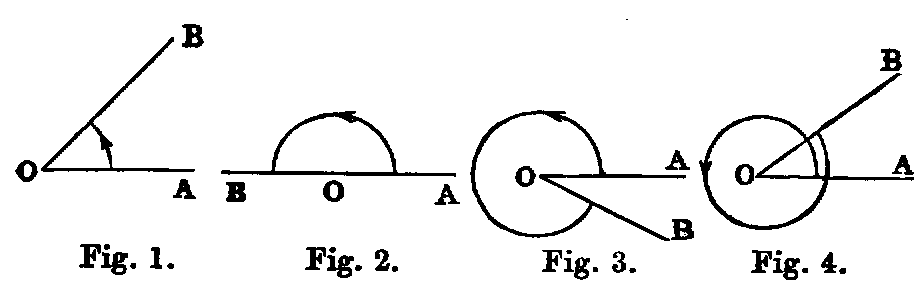
Thus, if a line OA revolve about the point O, as in figures 1, 2, 3, 4, until it comes into the position OB, the amount of the rotation from OA to OB is called an angle. From the diagrams we see that in fig. 1 it is less than two right angles; in fig. 2 it is equal to two right angles; in fig. 3 greater than two right angles, but less than four; and in fig. 4 it is greater than four right angles. The arrow-heads denote the direction or sense, as it is technically termed, in which the line OA turns. It is usual to call the direction indicated in the above figures positive, and the opposite negative. A line such as OA, which turns about a fixed point, is called a ray, and then we have the following definition:—
xvi. A ray which turns in the sense opposite to the hands of a watch describes a positive angle, and one which turns in the same direction as the hands, a negative angle.