Theorem. In any triangle (ABC), the square on any side subtending an acute angle (C) is less than the sum of the squares on the sides containing that angle, by twice the rectangle (BC, CD) contained by either of them (BC) and the intercept (CD) between the acute angle and the foot of the perpendicular on it from the opposite angle.
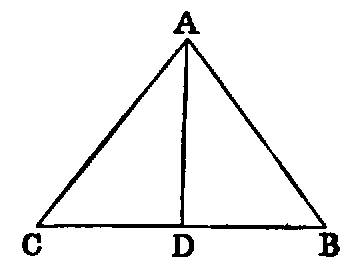
Dem.—Because BC is divided into two segments in D,
BC² + CD² = BD² + 2BC·CD [VII.]
and
AD2 = AD2.
Hence, adding, since
CD2 + AD2 = AC2 [I. xlvii.],
and BD2 + AD2 = AB2,
we get BC2 + AC2 = AB2 + 2BC.CD.
Therefore AB2 is less than BC2 + AC2 by 2BC.CD.
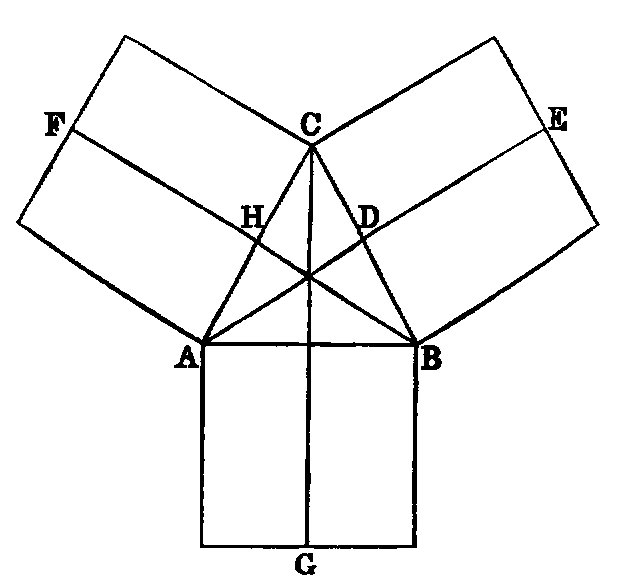
Or thus: Describe squares on the sides. Draw AE, BF, CG perpendicular to the sides; then, as in the demonstration of [I. xlvii.], the rectangle BG is equal to BE; AG to AF, and CE to CF. Hence the sum of the squares on AC, CB exceeds the square on AB by twice CE—that is, by 2BC.CD.
Observation.—By comparing the proofs of the pairs of Props. iv. and vii.; v. and vi.; ix. and x.; xii. and xiii., it will be seen that they are virtually identical. In order to render this identity more apparent, we have made some slight alterations in the usual proofs. The pairs of Propositions thus grouped are considered in Modern Geometry not as distinct, but each pair is regarded as one Proposition.