Theorem. If a line (AB) be divided into two parts (at C), the square on the sum of the whole line (AB) and either segment (BC) is equal to four times the rectangle contained by the whole line (AB) and that segment, together with the square on the other segment (AC).
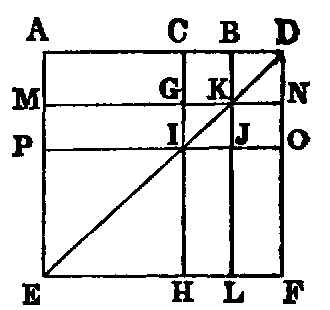
Dem.—Produce AB to D. Make BD equal to BC. On AD describe the square AEFD [I. xlvi.]. Join DE. Through C, B draw CH, BL parallel to AE [I. xxxi.], and through K, I draw MN, PO parallel to AD.
Since CO is the square on CD, and CK the square on CB, and CB is the half of CD, CO is equal to four times CK [iv., Cor. 1]. Again, since CG, GI are the sides of equal squares, they are equal [I. xlvi., Cor. 1]. Hence the parallelogram AG is equal to MI [I. xxxvi.]. In like manner IL is equal to JF; but MI is equal to IL [I. xliii.]. Therefore the four figures AG, MI, IL, JF are all equal; hence their sum is equal to four times AG; and the square CO has been proved to be equal to four times CK. Hence the gnomon AOH is equal to four times the rectangle AK—that is, equal to four times the rectangle AB.BC, since BC is equal to BK.
Again, the figure PH is the square on PI, and therefore equal to the square on AC. Hence the whole figure AF, that is, the square on AD, is equal to four times the rectangle AB.BC, together with the square on AC.
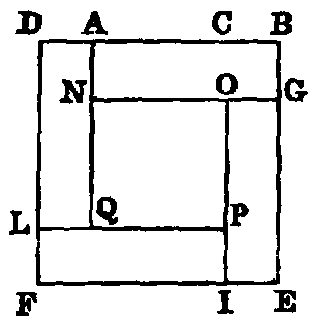
Or thus: Produce BA to D, and make AD = BC. On DB describe the square DBEF. Cut off BG, EI, FL each equal to BC. Through A and I draw lines parallel to DF, and through G and L, lines parallel to AB.
Now it is evident that the four rectangles. AG, GI, IL, LA are all equal; but AG is the rectangle AB.BG or AB.BC. Therefore the sum of the four rectangles is equal to 4AB.BC. Again, the figure NP is evidently equal to the square on AC. Hence the whole figure, which is the square on BD, or the square on the sum of AB and BC, is equal to 4AB.BC + AC2.
Or thus: AB + BC = AC + 2BC; therefore (AB + BC)2 = AC2 + 4AC.CB + 4BC2 = AC2 + 4(AC + CB).CB = AC2 + 4AB.BC. Direct sequence from v. or vi.
Since by v. or vi. the rectangle contained by any two lines is = the square on half their sum − the square on half their difference; therefore four times the rectangle contained by any two lines = the square on their sum − the square on their difference.
Direct sequence of viii. from iv. and vii.
By iv., the square on the sum = the sum of the squares + twice the rectangle.
By vii., the square on the difference = the sum of the squares − twice the rectangle. Therefore, by subtraction, the square on the sum − the square on the difference = four times the rectangle.