Theorem. If a line (AB) be divided into two equal parts (at C), and also into two unequal parts (at D), the rectangle (AD.DB) contained by the unequal parts, together with the square on the part (CD) between the points of section, is equal to the square on half the line.
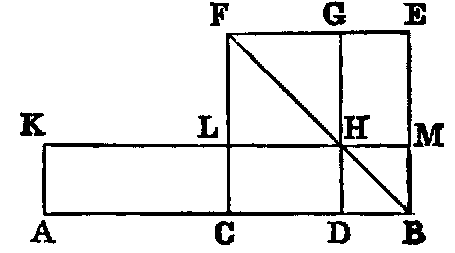
Dem.—On CB describe the square CBEF [I. xlvi.]. Join BF. Through D draw DG parallel to CF, meeting BF in H. Through H draw KM parallel to AB, and through A draw AK parallel to CL [I. xxxi.].
The parallelogram CM is equal to DE [I. xliii., Cor. 2]; but AL is equal to CM [I. xxxvi.], because they are on equal bases AC, CB, and between the same parallels; therefore AL is equal to DE: to each add CH, and we get the parallelogram AH equal to the gnomon CMG; but AH is equal to the rectangle AD.DH, and therefore equal to the rectangle AD.DB, since DH is equal to DB [iv., Cor. 1]; therefore the rectangle AD.DB is equal to the gnomon CMG, and the square on CD is equal to the figure LG. Hence the rectangle AD.DB, together with the square on CD, is equal to the whole figure CBEF—that is, to the square on CB.
Or thus: AD = AC + CD = BC + CD;
DB = BC − CD;
therefore AD.BD = (BC + CD)(BC − CD) = BC2 − CD2.
Hence
AD.BD + CD2 = BC2.
Cor. 1.—The rectangle AD.DB is the rectangle contained by the sum of the lines AC, CD and their difference; and we have proved it equal to the difference between the square on AC and the square on CD. Hence the difference of the squares on two lines is equal to the rectangle contained by their sum and their difference.
Cor. 2.—The perimeter of the rectangle AH is equal to 2AB, and is therefore independent of the position of the point D on the line AB; and the area of the same rectangle is less than the square on half the line by the square on the segment between D and the middle point of the line; therefore, when D is the middle point, the rectangle will have the maximum area. Hence, of all rectangles having the same perimeter, the square has the greatest area.