Theorem. If the square on one side (AB) of a triangle be equal to the sum of the squares on the remaining sides (AC, CB), the angle (C) opposite to that side is a right angle.
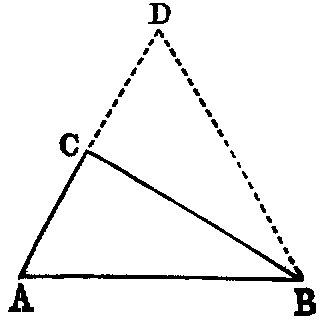
Dem.—Erect CD at right angles to CB [xi.], and make CD equal to CA [iii.]. Join BD. Then because AC is equal to CD, the square on AC is equal to the square on CD: to each add the square on CB, and we have the sum of the squares on AC, CB equal to the sum of the squares on CD, CB; but the sum of the squares on AC, CB is equal to the square on AB (hyp.), and the sum of the squares on CD, CB is equal to the square on BD [xlvii.]. Therefore the square on AB is equal to the square on BD. Hence AB is equal to BD [xlvi., Ex. 1]. Again, because AC is equal to CD (const.), and CB common to the two triangles ACB, DCB, and the base AB equal to the base DB, the angle ACB is equal to the angle DCB; but the angle DCB is a right angle (const.). Hence the angle ACB is a right angle.
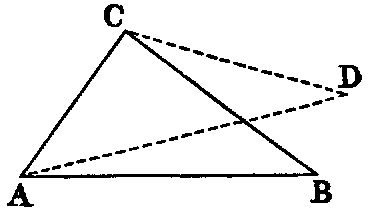
The foregoing proof forms an exception to Euclid’s demonstrations of converse propositions, for it is direct. The following is an indirect proof:—If CB be not at right angles to AC, let CD be perpendicular to it. Make CD = CB. Join AD. Then, as before, it can be proved that AD is equal to AB, and CD is equal to CB (const.). This is contrary to Prop. vii. Hence the angle ACB is a right angle.
Questions for Examination on Book I.
1. What is Geometry?
2. What is geometric magnitude? Ans. That which has extension in space.
3. Name the primary concepts of geometry. Ans. Points, lines, surfaces, and solids.
4. How may lines be divided? Ans. Into straight and curved.
5. How is a straight line generated? Ans. By the motion of a point which has the same direction throughout.
6. How is a curved line generated? Ans. By the motion of a point which continually changes its direction.
7. How may surfaces be divided? Ans. Into planes and curved surfaces.
8. How may a plane surface be generated. Ans. By the motion of a right line which crosses another right line, and moves along it without changing its direction.
9. Why has a point no dimensions?
10. Why has a line neither breadth nor thickness?
11. How many dimensions has a surface?
12. What is Plane Geometry?
13. What portion of plane geometry forms the subject of the “First Six Books of Euclid’s Elements”? Ans. The geometry of the point, line, and circle.
14. What is the subject-matter of Book I.?
15. How many conditions are necessary to fix the position of a point in a plane? Ans. Two; for it must be the intersection of two lines, straight or curved.
16. Give examples taken from Book I.
17. In order to construct a line, how many conditions must be given? Ans. Two; as, for instance, two points through which it must pass; or one point through which it must pass and a line to which it must be parallel or perpendicular, &c.
18. What problems on the drawing of lines occur in Book I.? Ans. ii., ix., xi., xii., xxiii., xxxi., in each of which, except Problem 2, there are two conditions. The direction in Problem 2 is indeterminate.
19. How many conditions are required in order to describe a circle? Ans. Three; as, for instance, the position of the centre (which depends on two conditions) and the length of the radius (compare Post. iii.).
20. How is a proposition proved indirectly? Ans. By proving that its contradictory is false.
21. What is meant by the obverse of a proposition?
22. What propositions in Book I. are the obverse respectively of Propositions iv., v., vi., xxvii.?
23. What proposition is an instance of the rule of identity?
24. What are congruent figures?
25. What other name is applied to them? Ans. They are said to be identically equal.
26. Mention all the instances of equality which are not congruence that occur in Book I.
27. What is the difference between the symbols denoting congruence and identity?
28. Classify the properties of triangles and parallelograms proved in Book I.
29. What proposition is the converse of Prop. xxvi., Part I.?
30. Define adjacent, exterior, interior, alternate angles respectively.
31. What is meant by the projection of one line on another?
32. What are meant by the medians of a triangle?
33. What is meant by the third diagonal of a quadrilateral?
34. Mention some propositions in Book I. which are particular cases of more general ones that follow.
35. What is the sum of all the exterior angles of any rectilineal figure equal to?
36. How many conditions must be given in order to construct a triangle? Ans. Three; such as the three sides, or two sides and an angle, &c.
Exercises on Book I.
1. Any triangle is equal to the fourth part of that which is formed by drawing through each vertex a line parallel to its opposite side.
2. The three perpendiculars of the first triangle in question 1 are the perpendiculars at the middle points of the sides of the second triangle.
3. Through a given point draw a line so that the portion intercepted by the legs of a given angle may be bisected in the point.
4. The three medians of a triangle are concurrent.
5. The medians of a triangle divide each other in the ratio of 2 : 1.
6. Construct a triangle, being given two sides and the median of the third side.
7. In every triangle the sum of the medians is less than the perimeter, and greater than three-fourths of the perimeter.
8. Construct a triangle, being given a side and the two medians of the remaining sides.
9. Construct a triangle, being given the three medians.
10. The angle included between the perpendicular from the vertical angle of a triangle on the base, and the bisector of the vertical angle, is equal to half the difference of the base angles.
11. Find in two parallels two points which shall be equidistant from a given point, and whose line of connexion shall be parallel to a given line.
12. Construct a parallelogram, being given two diagonals and a side.
13. The smallest median of a triangle corresponds to the greatest side.
14. Find in two parallels two points subtending a right angle at a given point and equally distant from it.
15. The sum of the distances of any point in the base of an isosceles triangle from the equal sides is equal to the distance of either extremity of the base from the opposite side.
16. The three perpendiculars at the middle points of the sides of a triangle are concurrent. Hence prove that perpendiculars from the vertices on the opposite sides are concurrent [see Ex. 2].
17. Inscribe a lozenge in a triangle having for an angle one angle of the triangle.
18. Inscribe a square in a triangle having its base on a side of the triangle.
19. Find the locus of a point, the sum or the difference of whose distance from two fixed lines is equal to a given length.
20. The sum of the perpendiculars from any point in the interior of an equilateral triangle is equal to the perpendicular from any vertex on the opposite side.
21. The distance of the foot of the perpendicular from either extremity of the base of a triangle on the bisector of the vertical angle, from the middle point of the base, is equal to half the difference of the sides.
22. In the same case, if the bisector of the external vertical angle be taken, the distance will be equal to half the sum of the sides.
23. Find a point in one of the sides of a triangle such that the sum of the intercepts made by the other sides, on parallels drawn from the same point to these sides, may be equal to a given length.
24. If two angles have their legs respectively parallel, their bisectors are either parallel or perpendicular.
25. If lines be drawn from the extremities of the base of a triangle to the feet of perpendiculars let fall from the same points on either bisector of the vertical angle, these lines meet on the other bisector of the vertical angle.
26. The perpendiculars of a triangle are the bisectors of the angles of the triangle whose vertices are the feet of these perpendiculars.
27. Inscribe in a given triangle a parallelogram whose diagonals shall intersect in a given point.
28. Construct a quadrilateral, the four sides being given in magnitude, and the middle points of two opposite sides being given in position.
29. The bases of two or more triangles having a common vertex are given, both in magnitude and position, and the sum of the areas is given; prove that the locus of the vertex is a right line.
30. If the sum of the perpendiculars let fall from a given point on the sides of a given rectilineal figure be given, the locus of the point is a right line.
31. ABC is an isosceles triangle whose equal sides are AB, AC; B′C′ is any secant cutting the equal sides in B′, C′, so that AB′ + AC′ = AB + AC: prove that B′C′ is greater than BC.
32. A, B are two given points, and P is a point in a given line L; prove that the difference of AP and PB is a maximum when L bisects the angle APB; and that their sum is a minimum if it bisects the supplement.
33. Bisect a quadrilateral by a right line drawn from one of its angular points.
34. AD and BC are two parallel lines cut obliquely by AB, and perpendicularly by AC; and between these lines we draw BED, cutting AC in E, such that ED = 2AB; prove that the angle DBC is one-third of ABC.
35. If O be the point of concurrence of the bisectors of the angles of the triangle ABC, and if AO produced meet BC in D, and from O, OE be drawn perpendicular to BC; prove that the angle BOD is equal to the angle COE.
36. If the exterior angles of a triangle be bisected, the three external triangles formed on the sides of the original triangle are equiangular.
37. The angle made by the bisectors of two consecutive angles of a convex quadrilateral is equal to half the sum of the remaining angles; and the angle made by the bisectors of two opposite angles is equal to half the difference of the two other angles.
38. If in the construction of the figure, Proposition xlvii., EF, KG be joined,
EF² + KG² = 5AB².
39. Given the middle points of the sides of a convex polygon of an odd number of sides, construct the polygon.
40. Trisect a quadrilateral by lines drawn from one of its angles.
41. Given the base of a triangle in magnitude and position and the sum of the sides; prove that the perpendicular at either extremity of the base to the adjacent side, and the external bisector of the vertical angle, meet on a given line perpendicular to the base.
42. The bisectors of the angles of a convex quadrilateral form a quadrilateral whose opposite angles are supplemental. If the first quadrilateral be a parallelogram, the second is a rectangle; if the first be a rectangle, the second is a square.
43. The middle points of the sides AB, BC, CA of a triangle are respectively D, E, F; DG is drawn parallel to BF to meet EF; prove that the sides of the triangle DCG are respectively equal to the three medians of the triangle ABC.
44. Find the path of a billiard ball started from a given point which, after being reflected from the four sides of the table, will pass through another given point.
45. If two lines bisecting two angles of a triangle and terminated by the opposite sides be equal, the triangle is isosceles.
46. State and prove the Proposition corresponding to Exercise 41, when the base and difference of the sides are given.
47. If a square be inscribed in a triangle, the rectangle under its side and the sum of the base and altitude is equal to twice the area of the triangle.
48. If AB, AC be equal sides of an isosceles triangle, and if BD be a perpendicular on AC; prove that BC2 = 2AC.CD.
49. The sum of the equilateral triangles described on the legs of a right-angled triangle is equal to the equilateral triangle described on the hypotenuse.
50. Given the base of a triangle, the difference of the base angles, and the sum or difference of the sides; construct it.
51. Given the base of a triangle, the median that bisects the base, and the area; construct it.
52. If the diagonals AC, BD of a quadrilateral ABCD intersect in E, and be bisected in the points F, G, then
4△EFG = (AEB + ECD) − (AED + EBC).
53. If squares be described on the sides of any triangle, the lines of connexion of the adjacent corners are respectively—(1) the doubles of the medians of the triangle; (2) perpendicular to them.