Problem. On a given right line (AB) to describe a square.
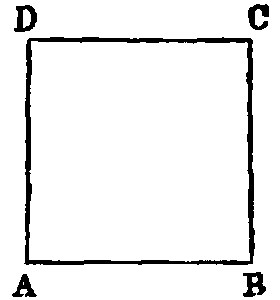
Sol.—Erect AD at right angles to AB [xi.], and make it equal to AB [iii.]. Through D draw DC parallel to AB [xxxi.], and through B draw BC parallel to AD; then AC is the square required.
Dem.—Because AC is a parallelogram, AB is equal to CD [xxxiv.]; but AB is equal to AD (const.); therefore AD is equal to CD, and AD is equal to BC [xxxiv.]. Hence the four sides are equal; therefore AC is a lozenge, and the angle A is a right angle. Therefore AC is a square (Def. xxx.).