Problem. To a given, right line (AB) to apply a parallelogram which shall be equal to a given triangle (C), and have one of its angles equal to a given angle (D).
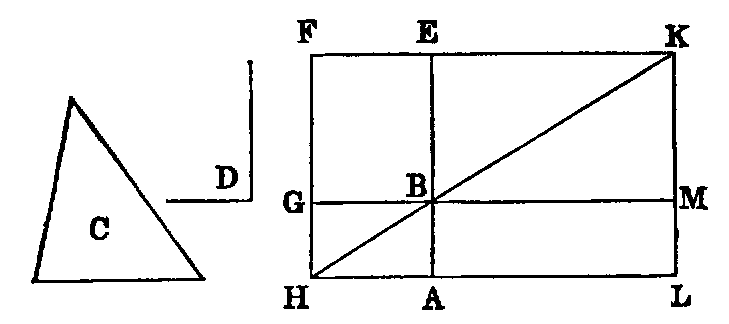
Sol.—Construct the parallelogram BEFG [xlii.] equal to the given triangle C, and having the angle B equal to the given angle D, and so that its side BE shall be in the same right line with AB. Through A draw AH parallel to BG [xxxi.], and produce FG to meet it in H. Join HB. Then because HA and FE are parallels, and HF intersects them, the sum of the angles AHF, HFE is two right angles [xxix.]; therefore the sum of the angles BHF, HFE is less than two right angles; and therefore (Axiom xii.) the lines HB, FE, if produced, will meet as at K. Through K draw KL parallel to AB [xxxi.], and produce HA and GB to meet it in the points L and M. Then AM is a parallelogram fulfilling the required conditions.
Dem.—The parallelogram AM is equal to GE [xliii.]; but GE is equal to the triangle C (const.); therefore AM is equal to the triangle C. Again, the angle ABM is equal to EBG [xv.], and EBG is equal to D (const.); therefore the angle ABM is equal to D; and AM is constructed on the given line; therefore it is the parallelogram required.