Problem. To construct a parallelogram equal to a given triangle (ABC), and having an angle equal to a given angle (D).
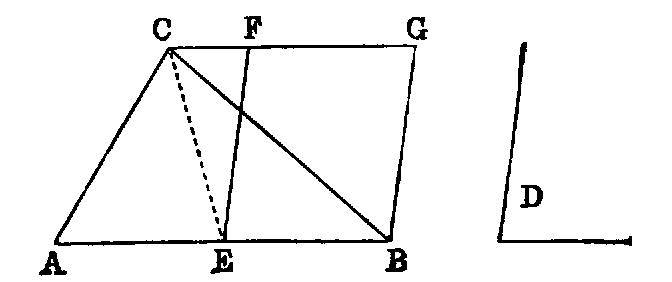
Sol.—Bisect AB in E. Join EC. Make the angle BEF [xxiii.] equal to D. Draw CG parallel to AB [xxxi.], and BG parallel to EF. EG is a parallelogram fulfilling the required conditions.
Dem.—Because AE is equal to EB (const.), the triangle AEC is equal to the triangle EBC [xxxviii.], therefore the triangle ABC is double of the triangle EBC; but the parallelogram EG is also double of the triangle EBC [xli.], because they are on the same base EB, and between the same parallels EB and CG. Therefore the parallelogram EG is equal to the triangle ABC, and it has (const.) the angle BEF equal to D. Hence EG is a parallelogram fulfilling the required conditions.