i. Things which are equal to the same, or to equals, are equal to each other.
Thus, if there be three things, and if the first, and the second, be each equal to the third, we infer by this axiom that the first is equal to the second. This axiom relates to all kinds of magnitude. The same is true of Axioms ii., iii., iv., v., vi., vii., ix.; but viii., x., xi., xii., are strictly geometrical.
ii. If equals be added to equals the sums will be equal.
iii. If equals be taken from equals the remainders will be equal.
iv. If equals be added to unequals the sums will be unequal.
v. If equals be taken from unequals the remainders will be unequal.
vi. The doubles of equal magnitudes are equal.
vii. The halves of equal magnitudes are equal.
viii. Magnitudes that can be made to coincide are equal.
The placing of one geometrical magnitude on another, such as a line on a line, a triangle on a triangle, or a circle on a circle, &c., is called superposition. The superposition employed in Geometry is only mental, that is, we conceive one magnitude placed on the other; and then, if we can prove that they coincide, we infer, by the present axiom, that they are equal. Superposition involves the following principle, of which, without explicitly stating it, Euclid makes frequent use:—“Any figure may be transferred from one position to another without change of form or size.”
ix. The whole is greater than its part.
This axiom is included in the following, which is a fuller statement:—
ix′. The whole is equal to the sum of all its parts.
x. Two right lines cannot enclose a space.
This is equivalent to the statement, “If two right lines have two points common to both, they coincide in direction,” that is, they form but one line, and this holds true even when one of the points is at infinity.
xi. All right angles are equal to one another.
This can be proved as follows:—Let there be two right lines AB, CD, and two perpendiculars to them, namely, EF, GH, then if AB, CD be made to coincide by superposition, so that the point E will coincide with G; then since a right angle is equal to its supplement, the line EF must coincide
with GH. Hence the angle AEF is equal to CGH.
xii. If two right lines (AB, CD) meet a third line (AC), so as to make the sum of the two interior angles (BAC, ACD) on the same side less than two right angles, these lines being produced shall meet at some finite distance.
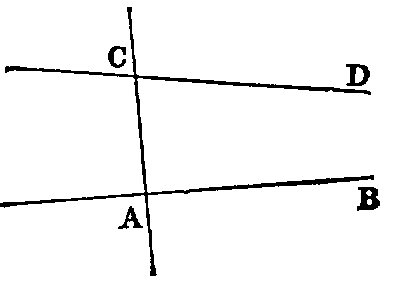
This axiom is the converse of Prop. xvii., Book I.
Explanation of Terms.
Axioms.—“Elements of human reason,” according to Dugald Stewart, are certain general propositions, the truths of which are self-evident, and which are so fundamental, that they cannot be inferred from any propositions which are more elementary; in other words, they are incapable of demonstration. “That two sides of a triangle are greater than the third” is, perhaps, self-evident; but it is not an axiom, inasmuch as it can be inferred by demonstration from other propositions; but we can give no proof of the proposition that “things which are equal to the same are equal to one another,” and, being self-evident, it is an axiom.
Propositions which are not axioms are properties of figures obtained by processes of reasoning. They are divided into theorems and problems.
A Theorem is the formal statement of a property that may be demonstrated from known propositions. These propositions may themselves be theorems or axioms. A theorem consists of two parts, the hypothesis, or that which is assumed, and the conclusion, or that which is asserted to follow therefrom. Thus, in the typical theorem,
If X is Y, then Z is W,
the hypothesis is that X is Y , and the conclusion is that Z is W.
Converse Theorems.—Two theorems are said to be converse, each of the other, when the hypothesis of either is the conclusion of the other. Thus the converse of the theorem (i.) is—
If Z is W, then X is Y.
From the two theorems (i.) and (ii.) we may infer two others, called their contrapositives. Thus the contrapositive
of (i.) is, If Z is not W, then X is not Y ; (iii.) of (ii.) is, If X is not Y , then Z is not W. (iv.) The theorem (iv.) is called the obverse of (i.), and (iii.) the obverse of (ii.).
A Problem is a proposition in which something is proposed to be done, such as a line to be drawn, or a figure to be constructed, under some given conditions.
The Solution of a problem is the method of construction which accomplishes the required end.
The Demonstration is the proof, in the case of a theorem, that the conclusion follows from the hypothesis; and in the case of a problem, that the construction accomplishes the object proposed.
The Enunciation of a problem consists of two parts, namely, the data, or things supposed to be given, and the quaesita, or things required to be done.
Postulates are the elements of geometrical construction, and occupy the same relation with respect to problems as axioms do to theorems.
A Corollary is an inference or deduction from a proposition.
A Lemma is an auxiliary proposition required in the demonstration of a principal proposition.
A Secant or Transversal is a line which cuts a system of lines, a circle, or any other geometrical figure.
Congruent figures are those that can be made to coincide by superposition. They agree in shape and size, but differ in position. Hence it follows, by Axiom viii., that corresponding parts or portions of congruent figures are congruent, and that congruent figures are equal in every respect.
Rule of Identity.—Under this name the following principle will be sometimes referred to:—“If there is but one X and one Y , then, from the fact that X is Y , it necessarily follows that Y is X.”—Syllabus.