Theorem. Parallelograms on the same base (BC) and between the same parallels are equal.
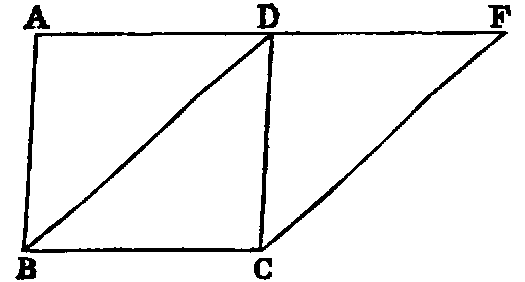
Dem.—1. Let the sides AD, DF of the parallelograms AC, BF opposite to the common base BC terminate in the same point D, then [xxxiv.] each parallelogram is double of the triangle BCD. Hence they are equal to one another.
2. Let the sides AD, EF (figures (α), (β)) opposite to BC not terminate in the same point.
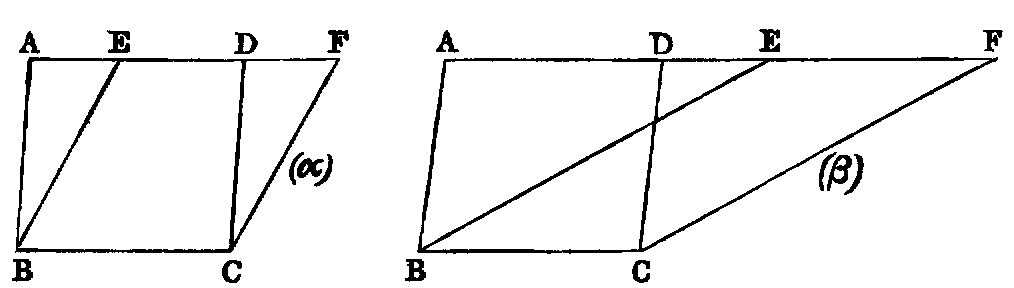
Then because ABCD is a parallelogram, AD is equal to BC [xxxiv.]; and since BCEF is a parallelogram, EF is equal to BC; therefore (see fig. (α)) take away ED, and in fig. (β) add ED, and we have in each case AE equal to DF, and BA is equal to CD [xxxiv.]. Hence the triangles BAE, CDF have the two sides BA, AE in one respectively equal to the two sides CD, DF in the other, and the angle BAE [xxix.] equal to the angle CDF; hence [iv.] the triangle BAE is equal to the triangle CDF; and taking each of these triangles in succession from the quadrilateral BAFC, there will remain the parallelogram BCFE equal to the parallelogram BCDA.
Or thus: The triangles ABE, DCF have [xxxiv.] the sides AB, BE in one respectively equal to the sides DC, CF in the other, and the angle ABE equal to the angle DCF [xxix., Ex. 8]. Hence the triangle ABE is equal to the triangle DCF; and, taking each away from the quadrilateral BAFC, there will remain the parallelogram BCFE equal to the parallelogram BCDA.
Observation.—By the second method of proof the subdivision of the demonstration into cases is avoided. It is easy to see that either of the two parallelograms ABCD, EBCF can be divided into parts and rearranged so as to make it congruent with the other. This Proposition affords the first instance in the Elements in which equality which is not congruence occurs. This equality is expressed algebraically by the symbol =, while congruence is denoted by ≡, called also the symbol of identity. Figures that are congruent are said to be identically equal.