Theorem. The right lines (AC, BD) which join the adjacent extremities of two equal and parallel right lines (AB, CD) are equal and parallel.
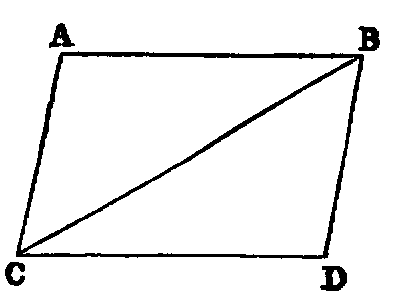
Dem.—Join BC. Now since AB is parallel to CD, and BC intersects them, the angle ABC is equal to the alternate angle DCB [xxix.]. Again, since AB is equal to CD, and BC common, the triangles ABC, DCB have the sides AB, BC in one respectively equal to the sides DC, CB in the other, and the angles ABC, DCB contained by those sides equal; therefore [iv.] the base AC is equal to the base BD, and the angle ACB is equal to the angle CBD; but these are alternate angles; hence [xxvii.] AC is parallel to BD, and it has been proved equal to it. Therefore AC is both equal and parallel to BD.