Theorem. The sum of any two sides (BA, AC) of a triangle (ABC) is greater than the third.
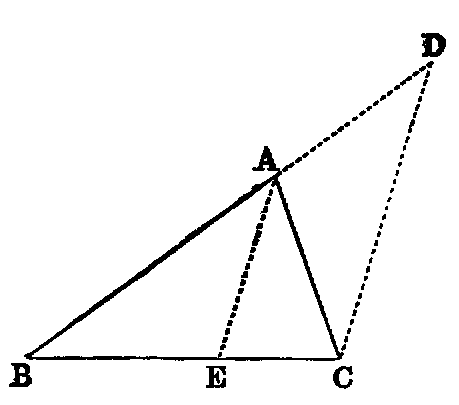
Dem.—Produce BA to D (Post. ii.), and make AD equal to AC [iii.]. Join CD. Then because AD is equal to AC, the angle ACD is equal to ADC (v.); therefore the angle BCD is greater than the angle BDC; hence the side BD opposite to the greater angle is greater than BC opposite to the less [xix.]. Again, since AC is equal to AD, adding BA to both, we have the sum of the sides BA, AC equal to BD. Therefore the sum of BA, AC is greater than BC.
Or thus: Bisect the angle BAC by AE [ix.] Then the angle BEA is greater than EAC; but EAC = EAB (const.); therefore the angle BEA is greater than EAB. Hence AB is greater than BE [xix.]. In like manner AC is greater than EC. Therefore the sum of BA, AC is greater than BC.