Theorem. If in any triangle (ABC) one side (AC) be greater than another (AB), the angle opposite to the greater side is grater than the angle opposite to the less.
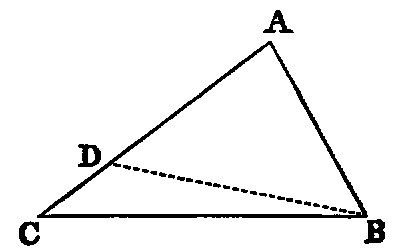
Dem.—From AC cut off AD equal to AB [iii]. Join BD (Post. i.). Now since AB is equal to AD, the triangle ABD is isosceles; therefore [v.] the angle ADB is equal to ABD; but the angle ADB is greater than the angle ACB [xvi.]; therefore ABD is greater than ACB. Much more is the angle ABC greater than the angle ACB.
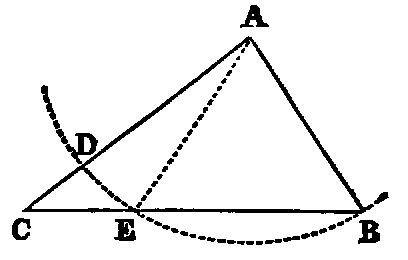
Or thus: From A as centre, with the lesser side AB as radius, describe the circle BED, cutting BC in E. Join AE. Now since AB is equal to AE, the angle AEB is equal to ABE; but AEB is greater than ACB (xvi.); therefore ABE is greater than ACB.