Problem. To bisect a given finite right line (AB).
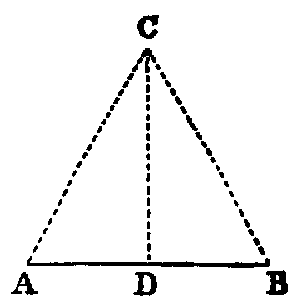
Sol.—Upon AB describe an equilateral triangle ACB [i.]. Bisect the angle ACB by the line CD [ix.], meeting AB in D, then AB is bisected in D.
Dem.—The two triangles ACD, BCD, have the side AC equal to BC, being the sides of an equilateral triangle, and CD common. Therefore the two sides AC, CD in one are equal to the two sides BC, CD in the other; and the angle ACD is equal to the angle BCD (const.). Therefore the base AD is equal to the base DB [iv.]. Hence AB is bisected in D.