Problem. About a given circle (ABCD) to describe a square.
Sol.—Through the centre O draw any two diameters at right angles to each other, and draw at the points A, B, C, D the lines HE, EF, FG, GH touching the circle. EFGH is a square.
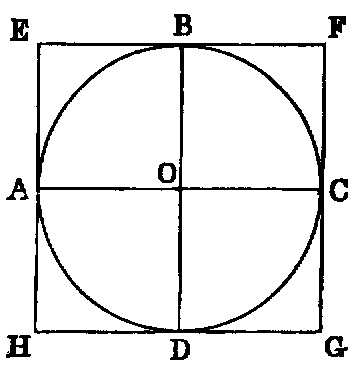
Dem.—Because AE touches the circle at A, the angle EAO is right [III. xviii.], and therefore equal to BOC, which is right (const.). Hence AE is parallel to OB. In like manner EB is parallel to AO; and since AO is equal to OB, the figure AOBE is a lozenge, and the angle AOB is right; hence AOBE is a square. In like manner each of the figures BC, CD, DA is a square. Hence the whole figure is a square.
Cor.—The circumscribed square is double of the inscribed square.