Problem. To describe a circle about a given triangle (ABC).
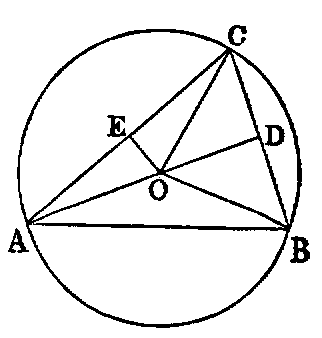
Sol.—Bisect any two sides BC, AC in the points D, E. Erect DO, EO at right angles to BC, CA; then O, the point of intersection of the perpendiculars, is the centre of the required circle.
Dem.—Join OA, OB, OC. The triangles BDO, CDO have the side BD equal CD (const.), and DO common, and the angle BDO equal to the angle CDO, because each is right. Hence [I. iv.] BO is equal to OC. In like manner AO is equal to OC. Therefore the three lines AO, BO, CO are equal, and the circle described with O as centre, and OA as radius, will pass through the points A, B, C, and be described about the triangle ABC.
Cor. 1.—Since the perpendicular from O on AB bisects it [III. iii.], we see that the perpendiculars at the middle points of the sides of a triangle are concurrent.
Def.—The circle ABC is called the circumcircle, its radius the circumradius, and its centre the circumcentre of the triangle.