Problem. About a given circle (ABC) to describe a triangle equiangular to a given triangle (DEF).
Sol.—Produce any side DE of the given triangle both ways to G and H, and from the centre O of the circle draw any radius OA; make the angle AOB equal to GEF [I. xxiii.], and the angle AOC equal to HDF. At the points A, B, C draw the tangents LM, MN, NL to the given circle. LMN is a triangle fulfilling the required conditions.
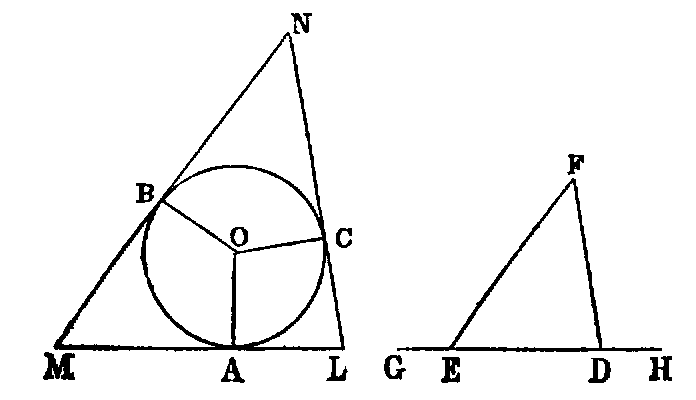
Dem.—Because AM touches the circle at A, the angle OAM is right. In like manner, the angle MBO is right; but the sum of the four angles of the quadrilateral OAMB is equal to four right angles. Therefore the sum of the two remaining angles AOB, AMB is two right angles; and [I. xiii.] the sum of the two angles GEF, FED is two right angles. Therefore the sum of AOB, AMB is equal to the sum of GEF, FED; but AOB is equal to GEF (const.). Hence AMB is equal to FED. In like manner, ALC is equal to EDF; therefore [I. xxxii.] the remaining angle BNC is equal to DFE. Hence the triangle LMN is equiangular to DEF.