Theorem. In a circle—(1). The angle in a semicircle is a right angle. (2). The angle in a segment greater than a semicircle is an acute angle. (3). The angle in a segment less than a semicircle is an obtuse angle.
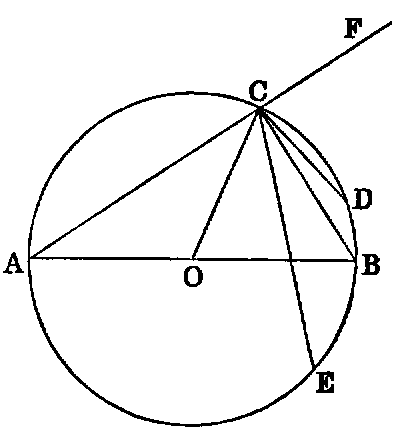
Dem.—(1). Let AB be the diameter, C any point in the semicircle. Join AC, CB. The angle ACB is a right angle.
For let O be the centre. Join OC, and produce AC to F. Then because AO is equal to OC, the angle ACO is equal to the angle OAC. In like manner, the angle OCB is equal to CBO. Hence the angle ACB is equal to the sum of the two angles BAC, CBA; but [I. xxxii.] the angle FCB is equal to the sum of the two interior angles BAC, CBA of the triangle ABC. Hence the angle ACB is equal to its adjacent angle FCB, and therefore it is a right angle [I. Def. xiii.].
(2). Let the arc ACE be greater than a semicircle. Join CE. Then the angle ACE is evidently less than ACB; but ACB is right; therefore ACE is acute.
(3). Let the arc ACD be less than a semicircle; then evidently, from (1), the angle ACD is obtuse.
Cor. 1.—If a parallelogram be inscribed in a circle, its diagonals intersect at the centre of the circle.
Cor. 2.—Find the centre of a circle by means of a carpenter’s square.
Cor. 3.—From a point outside a circle draw two tangents to the circle.