Theorem. If two angles (B, C) of a triangle be equal, the sides (AC, AB) opposite to them are also equal.
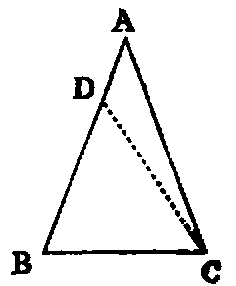
Dem.—If AB, AC are not equal, one must be greater than the other. Suppose AB is the greater, and that the part BD is equal to AC. Join CD (Post. i.). Then the two triangles DBC, ACB have BD equal to AC, and BC common to both. Therefore the two sides DB, BC in one are equal to the two sides AC, CB in the other; and the angle DBC in one is equal to the angle ACB in the other (hyp). Therefore [iv.] the triangle DBC is equal to the triangle ACB—the less to the greater, which is absurd; hence AC, AB are not unequal, that is, they are equal.