The ratio of the circumference of any circle to its diameter is less than 3 1/7 but greater than 3 10/71.
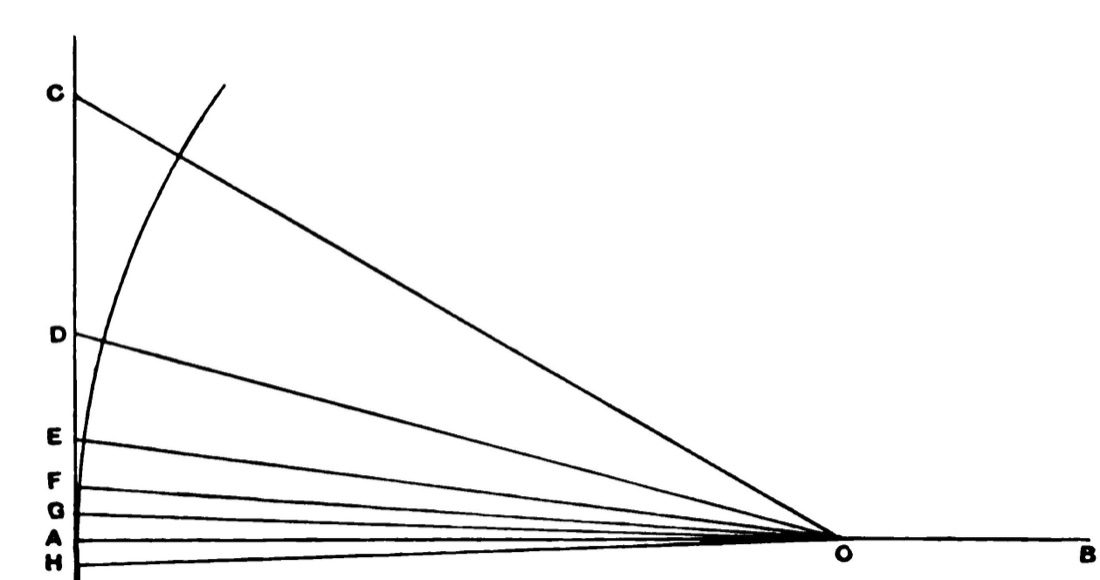
3 10 71 < π < 3 1 7 3\frac{10}{71} < \pi < 3\frac{1}{7} 3 71 10 < π < 3 7 1 PART I. Let AB be the diameter of any circle, O its centre, AC the tangent at A; and let the angle AOC be one-third of a right angle.
Then O A : A C [ = 3 : 1 ] > 265 : 153 ( 1 ) and O C : C A [ = 2 : 1 ] = 306 : 153 ( 2 ) \begin{aligned} &\text{Then}\quad OA:AC\,[=\sqrt{3}:1] > 265:153 \quad (1)\\ &\text{and}\quad OC:CA\,[=2:1] = 306:153 \quad (2)\end{aligned} Then O A : A C [ = 3 : 1 ] > 265 : 153 ( 1 ) and O C : C A [ = 2 : 1 ] = 306 : 153 ( 2 ) First, draw OD bisecting the angle AOC and meeting AC in D.
Now C O : O A = C D : D A [ Eucl. VI. 3 ] so that C O + O A : C A = O A : A D Therefore [by (1), (2)] O A : A D > 571 : 153 ( 3 ) Hence O D 2 : A D 2 = ( O A 2 + A D 2 ) : A D 2 > 349450 : 23409 so that O D : D A > 591 1 8 : 153 ( 4 ) \begin{aligned} &\text{Now}\quad CO:OA = CD:DA \qquad [\text{Eucl. VI. 3}]\\ &\text{so that}\quad CO+OA:CA = OA:AD\\ &\text{Therefore [by (1), (2)]}\quad OA:AD > 571:153 \quad (3)\\ &\text{Hence}\quad OD^2:AD^2 = (OA^2+AD^2):AD^2 > 349450:23409\\ &\text{so that}\quad OD:DA > 591\frac{1}{8}:153 \quad (4)\end{aligned} Now C O : O A = C D : D A [ Eucl. VI. 3 ] so that C O + O A : C A = O A : A D Therefore [by (1), (2)] O A : A D > 571 : 153 ( 3 ) Hence O D 2 : A D 2 = ( O A 2 + A D 2 ) : A D 2 > 349450 : 23409 so that O D : D A > 591 8 1 : 153 ( 4 ) T. L. Heath, The Works of Archimedes (Cambridge, 1897) Secondly, let OE bisect the angle AOD, meeting AD in E.
so that D O + O A : D A = O A : A E Therefore O A : A E > 1162 1 8 : 153 ( 5 ) Hence O E 2 : E A 2 > ( 1162 1 8 ) 2 + 153 2 : 153 2 > 1373943 33 64 : 23409 Thus O E : E A > 1172 1 8 : 153 ( 6 ) \begin{aligned} &\text{so that}\quad DO+OA:DA = OA:AE\\ &\text{Therefore}\quad OA:AE > 1162\frac{1}{8}:153 \quad (5)\\ &\text{Hence}\quad OE^2:EA^2 > (1162\frac{1}{8})^2+153^2:153^2 > 1373943\frac{33}{64}:23409\\ &\text{Thus}\quad OE:EA > 1172\frac{1}{8}:153 \quad (6)\end{aligned} so that D O + O A : D A = O A : A E Therefore O A : A E > 1162 8 1 : 153 ( 5 ) Hence O E 2 : E A 2 > ( 1162 8 1 ) 2 + 15 3 2 : 15 3 2 > 1373943 64 33 : 23409 Thus O E : E A > 1172 8 1 : 153 ( 6 ) Thirdly, let OF bisect the angle AOE and meet AE in F. We thus obtain the result that
O A : A F [ > ( 1162 1 8 + 1172 1 8 ) : 153 ] > 2334 1 4 : 153 ( 7 ) Therefore O F : F A > 2339 1 4 : 153 ( 8 ) \begin{aligned} &OA:AF\,[> (1162\frac{1}{8}+1172\frac{1}{8}):153] > 2334\frac{1}{4}:153 \quad (7)\\ &\text{Therefore}\quad OF:FA > 2339\frac{1}{4}:153 \quad (8)\end{aligned} O A : A F [ > ( 1162 8 1 + 1172 8 1 ) : 153 ] > 2334 4 1 : 153 ( 7 ) Therefore O F : F A > 2339 4 1 : 153 ( 8 ) Fourthly, let OG bisect the angle AOF, meeting AF in G. We have then
O A : A G [ > ( 2334 1 4 + 2339 1 4 ) : 153 , by (7), (8) ] > 4673 1 2 : 153 OA:AG\,[> (2334\frac{1}{4}+2339\frac{1}{4}):153,\ \text{by (7), (8)}] > 4673\frac{1}{2}:153 O A : A G [ > ( 2334 4 1 + 2339 4 1 ) : 153 , by (7), (8) ] > 4673 2 1 : 153 Now the angle AOC, one-third of a right angle, has been bisected four times, so the angle AOG is 1/48 of a right angle. Make the angle AOH on the other side of OA equal to angle AOG, and let GA produced meet OH in H; then angle GOH is 1/24 of a right angle. Thus GH is one side of a regular polygon of 96 sides circumscribed to the given circle.
Since O A : A G > 4673 1 2 : 153 , while A B = 2 O A , G H = 2 A G , A B : ( perimeter of 96-gon ) [ > 4673 1 2 : 153 × 96 ] > 4673 1 2 : 14688 But 14688 4673 1 2 = 3 + 667 1 2 4673 1 2 < 3 1 7 \begin{aligned} &\text{Since}\quad OA:AG > 4673\frac{1}{2}:153,\ \text{while}\ AB=2OA,\ GH=2AG,\\ &AB:(\text{perimeter of 96-gon})\,[> 4673\frac{1}{2}:153\times 96] > 4673\frac{1}{2}:14688\\ &\text{But}\quad \frac{14688}{4673\frac{1}{2}} = 3 + \frac{667\frac{1}{2}}{4673\frac{1}{2}} < 3\frac{1}{7}\end{aligned} Since O A : A G > 4673 2 1 : 153 , while A B = 2 O A , G H = 2 A G , A B : ( perimeter of 96-gon ) [ > 4673 2 1 : 153 × 96 ] > 4673 2 1 : 14688 But 4673 2 1 14688 = 3 + 4673 2 1 667 2 1 < 3 7 1 Therefore the circumference of the circle (being less than the perimeter of the polygon) is a fortiori less than 3 1/7 times the diameter AB.
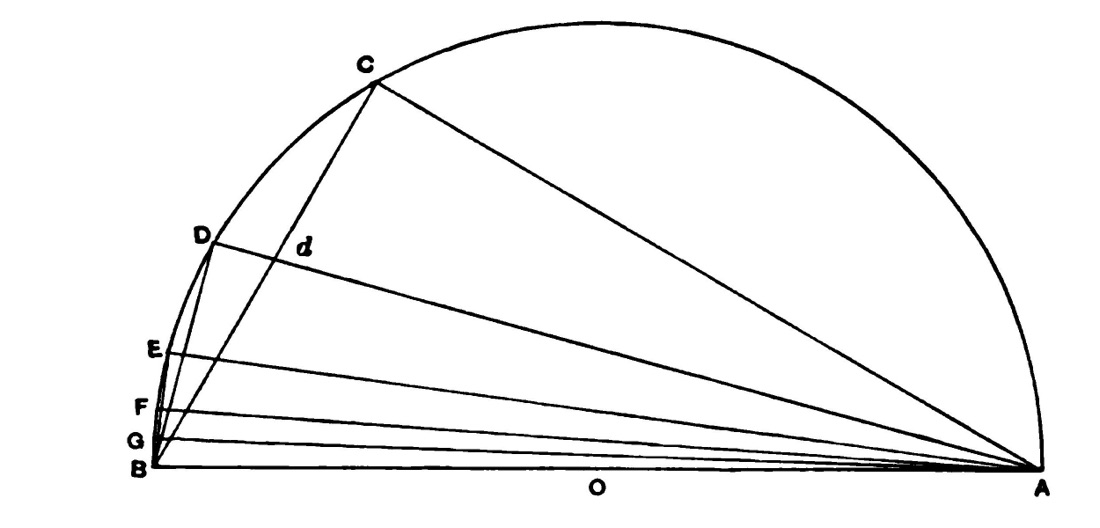
PART II. Next let AB be the diameter of a circle, and let AC, meeting the circle in C, make the angle CAB equal to one-third of a right angle. Join BC.
Then A C : C B [ = 3 : 1 ] < 1351 : 780 \text{Then}\quad AC:CB\,[=\sqrt{3}:1] < 1351:780 Then A C : C B [ = 3 : 1 ] < 1351 : 780 First, let AD bisect the angle BAC and meet BC in d and the circle in D. Join BD. The triangles ADB, ACd, BDd are similar, whence
T. L. Heath, The Works of Archimedes (Cambridge, 1897) B A + A C : B C = A D : D B [But A C : C B < 1351 : 780 , while B A : B C = 1560 : 780 ] Therefore A D : D B < 2911 : 780 ( 1 ) [Hence A B 2 : B D 2 < ( 2911 2 + 780 2 ) : 780 2 < 9082321 : 608400 ] Thus A B : B D < 3013 3 4 : 780 ( 2 ) \begin{aligned} &BA+AC:BC = AD:DB\\ &\text{[But}\ AC:CB < 1351:780,\ \text{while}\ BA:BC = 1560:780]\\ &\text{Therefore}\quad AD:DB < 2911:780 \quad (1)\\ &\text{[Hence}\ AB^2:BD^2 < (2911^2+780^2):780^2 < 9082321:608400]\\ &\text{Thus}\quad AB:BD < 3013\frac{3}{4}:780 \quad (2)\end{aligned} B A + A C : B C = A D : D B [But A C : C B < 1351 : 780 , while B A : B C = 1560 : 780 ] Therefore A D : D B < 2911 : 780 ( 1 ) [Hence A B 2 : B D 2 < ( 291 1 2 + 78 0 2 ) : 78 0 2 < 9082321 : 608400 ] Thus A B : B D < 3013 4 3 : 780 ( 2 ) Secondly, let AE bisect the angle BAD, meeting the circle in E; and let BE be joined. Then we prove, in the same way as before, that
A E : E B [ = B A + A D : B D < ( 3013 3 4 + 2911 ) : 780 ] < 5924 3 4 : 780 < 5924 3 4 × 4 13 : 780 × 4 13 < 1823 : 240 ( 3 ) Therefore A B : B E < 1838 9 11 : 240 ( 4 ) \begin{aligned} &AE:EB\,[= BA+AD:BD < (3013\frac{3}{4}+2911):780] < 5924\frac{3}{4}:780\\ &\quad < 5924\frac{3}{4}\times\frac{4}{13}:780\times\frac{4}{13} < 1823:240 \quad (3)\\ &\text{Therefore}\quad AB:BE < 1838\frac{9}{11}:240 \quad (4)\end{aligned} A E : E B [ = B A + A D : B D < ( 3013 4 3 + 2911 ) : 780 ] < 5924 4 3 : 780 < 5924 4 3 × 13 4 : 780 × 13 4 < 1823 : 240 ( 3 ) Therefore A B : B E < 1838 11 9 : 240 ( 4 ) Thirdly, let AF bisect the angle BAE, meeting the circle in F.
A F : F B [ = B A + A E : B E < 3661 9 11 : 240 ] < 3661 9 11 × 11 40 : 240 × 11 40 < 1007 : 66 ( 5 ) Therefore A B : B F < 1009 1 6 : 66 ( 6 ) \begin{aligned} &AF:FB\,[= BA+AE:BE < 3661\frac{9}{11}:240] < 3661\frac{9}{11}\times\frac{11}{40}:240\times\frac{11}{40}\\ &\quad < 1007:66 \quad (5)\\ &\text{Therefore}\quad AB:BF < 1009\frac{1}{6}:66 \quad (6)\end{aligned} A F : F B [ = B A + A E : B E < 3661 11 9 : 240 ] < 3661 11 9 × 40 11 : 240 × 40 11 < 1007 : 66 ( 5 ) Therefore A B : B F < 1009 6 1 : 66 ( 6 ) Fourthly, let the angle BAF be bisected by AG meeting the circle in G.
Then A G : G B [ = B A + A F : B F ] < 2016 1 6 : 66 [ by (5), (6) ] [And A B 2 : B G 2 < ( 2016 1 6 ) 2 + 66 2 : 66 2 < 4069284 1 36 : 4356 ] Therefore A B : B G < 2017 1 4 : 66 , whence B G : A B > 66 : 2017 1 4 ( 7 ) \begin{aligned} &\text{Then}\quad AG:GB\,[= BA+AF:BF] < 2016\frac{1}{6}:66 \quad [\text{by (5), (6)}]\\ &\text{[And}\ AB^2:BG^2 < (2016\frac{1}{6})^2+66^2:66^2 < 4069284\frac{1}{36}:4356]\\ &\text{Therefore}\quad AB:BG < 2017\frac{1}{4}:66,\ \text{whence}\ BG:AB > 66:2017\frac{1}{4} \quad (7)\end{aligned} Then A G : GB [ = B A + A F : B F ] < 2016 6 1 : 66 [ by (5), (6) ] [And A B 2 : B G 2 < ( 2016 6 1 ) 2 + 6 6 2 : 6 6 2 < 4069284 36 1 : 4356 ] Therefore A B : B G < 2017 4 1 : 66 , whence B G : A B > 66 : 2017 4 1 ( 7 ) Now the angle BAG, the result of the fourth bisection of the angle BAC, is one-forty-eighth of a right angle, so the angle subtended by BG at the centre is 1/24 of a right angle. Therefore BG is a side of a regular inscribed polygon of 96 sides.
( perimeter of 96-gon ) : A B [ > 96 × 66 : 2017 1 4 ] > 6336 : 2017 1 4 And 6336 2017 1 4 > 3 10 71 \begin{aligned} &(\text{perimeter of 96-gon}):AB\,[> 96\times 66:2017\frac{1}{4}] > 6336:2017\frac{1}{4}\\ &\text{And}\quad \frac{6336}{2017\frac{1}{4}} > 3\frac{10}{71}\end{aligned} ( perimeter of 96-gon ) : A B [ > 96 × 66 : 2017 4 1 ] > 6336 : 2017 4 1 And 2017 4 1 6336 > 3 71 10 Much more then is the circumference of the circle greater than 3 10/71 times the diameter.
Thus the ratio of the circumference to the diameter is < 3 1 7 but > 3 10 71 \text{Thus the ratio of the circumference to the diameter is}\ < 3\frac{1}{7}\ \text{but}\ > 3\frac{10}{71} Thus the ratio of the circumference to the diameter is < 3 7 1 but > 3 71 10